# Best Trust Centers in 2026: A European Buyer's Guide
A practical framework to evaluate trust center platforms in 2026, with a shortlist by use case and buyer expectations.
**The best trust center in 2026 depends on your buyer profile, not a single ranking.** US-centric teams with heavy CRM workflows tend to pick SafeBase (now part of Drata) or Conveyor; existing Vanta or Secureframe customers usually enable the bundled option; and European startups and mid-market companies that need EU data residency by default, transparent pricing, and content built around ISO 27001, NIS2, and DORA increasingly favour standalone, EU-built platforms like Orbiq. This guide gives you a framework to choose — including two factors that barely existed a year ago: genuine EU data sovereignty and machine-readable, AI-readable evidence.
Security reviews are slowing down your sales cycle. Your security team scrambles to respond, spreadsheets multiply, and deals stall for weeks. Trust center platforms solve this by letting you proactively share your security posture, compliance certifications, and documentation — before prospects even ask.[1](#ref-1),[2](#ref-2),[3](#ref-3)
But not all trust centers are built equal, especially for European companies navigating GDPR, NIS2, DORA, and increasingly strict data residency requirements.[4](#ref-4),[5](#ref-5) If you are new to the category, start with [what a trust centre is](/trust-center/what-is-a-trust-center) and then come back here. This guide compares leading trust center platforms, with a specific focus on what matters to **EU-based SaaS and mid-market companies**.
## Quick Comparison
**At a glance: who each platform is really for**
| Platform | Best For | EU Data Residency | AI Questionnaire Automation | Standalone vs Bundled | Pricing Transparency |
| ---------------------------- | ------------------------------------------------------------------------ | ----------------------------------------------- | ------------------------------------------------------------------------------------------------- | ----------------------------------------------------------------------- | ---------------------------------------------------------------------------------- |
| **Orbiq** | EU startups and mid‑market companies wanting simplicity + sophistication | **EU‑first by default** | Emerging, focused on EU‑relevant content structure | Standalone trust center | Public pricing; free tier |
| **SafeBase (by Drata)** | Larger companies with complex security reviews, esp. US‑centric | US‑default, EU options typically higher tiers | Strong AI‑assisted workflows | Standalone, but now part of Drata ecosystem | "Contact sales"; enterprise‑oriented[6](#ref-6),[7](#ref-7),[8](#ref-8) |
| **Vanta Trust Center** | Existing Vanta compliance customers | US‑default, EU options depend on platform setup | Integrated with Vanta's broader AI features | Bundled with Vanta GRC platform[9](#ref-9) | Pricing bundled; not easy to isolate[9](#ref-9),[3](#ref-3) |
| **Secureframe Trust Center** | Existing Secureframe customers | US‑default, EU hosting by arrangement | Focused more on compliance data than AI-first | Bundled with Secureframe platform[10](#ref-10),[11](#ref-11) | Part of Secureframe pricing; sales-led[10](#ref-10),[12](#ref-12) |
| **Conveyor** | Teams drowning in security questionnaires | US‑centric, with some EU-conscious customers | One of the strongest AI questionnaire engines[1](#ref-1),[13](#ref-13),[14](#ref-14) | Standalone trust center + questionnaire automation | Public pricing with usage-based components[3](#ref-3),[13](#ref-13) |
| **TrustCloud** | Larger enterprises needing trust + vendor risk together | US‑centric, enterprise buyers | AI‑heavy "Assurance AI" and TrustShare portal[15](#ref-15),[16](#ref-16),[17](#ref-17) | Part of broader trust/risk platform | Enterprise pricing; sales-led[15](#ref-15),[16](#ref-16),[12](#ref-12) |
This table is intentionally opinionated: it reflects how these tools are positioned publicly and how buyers and practitioners describe them in reviews, blogs, and community discussions.[1](#ref-1),[18](#ref-18),[12](#ref-12),[3](#ref-3),[19](#ref-19)
## How This Guide Evaluated Platforms
The landscape of trust center platforms is still young. Most tools either:
- Grew out of **GRC/compliance automation suites** (Vanta, Drata/SafeBase, Secureframe, Scytale, OneTrust, Hyperproof), or[10](#ref-10),[9](#ref-9),[1](#ref-1),[12](#ref-12),[4](#ref-4)
- Started as **questionnaire-automation or trust-portal specialists** (Conveyor, TrustCloud, Vendict, SecurityPal, Orbiq).[16](#ref-16),[1](#ref-1),[18](#ref-18),[3](#ref-3),[20](#ref-20)
This guide focuses on how useful each tool is for **European buyers**. Evaluation categories:
- **Core functionality**
Public trust portal, document sharing & gating, NDA/approval workflows, analytics.
- **EU compliance readiness**
GDPR support, NIS2/DORA awareness, handling of DPAs and subprocessors, EU-relevant certifications (ISO 27001, etc.).[4](#ref-4),[5](#ref-5)
- **Data residency & sovereignty**
EU hosting options, data sovereignty considerations (which jurisdiction's laws apply), clarity of subprocessors, whether EU residency is default vs enterprise add‑on.[9](#ref-9),[1](#ref-1),[12](#ref-12),[3](#ref-3)
- **Professional features**
Tiered access controls, watermarking, branding, custom domains, SSO.
- **Integrations**
CRM (Salesforce, HubSpot), ticketing (Jira), contracts (DocuSign, Ironclad), Slack/Teams, API and webhooks.[9](#ref-9),[1](#ref-1),[2](#ref-2),[3](#ref-3)
- **AI capabilities**
AI-powered search, questionnaire automation, use of security‑trained models vs generic LLMs, controls to avoid hallucinations.[15](#ref-15),[16](#ref-16),[1](#ref-1),[18](#ref-18),[2](#ref-2)
- **Pricing and transparency**
Published pricing vs "contact sales", meaningful free tiers vs marketing-only "free", whether trust center is bundled into a bigger platform.[1](#ref-1),[12](#ref-12),[3](#ref-3),[20](#ref-20)
Where possible, this guide triangulates **vendor documentation, third‑party comparison blogs, review sites, and community threads**.[1](#ref-1),[18](#ref-18),[12](#ref-12),[3](#ref-3),[19](#ref-19)
## Platform Reviews
### Orbiq
**Overview**
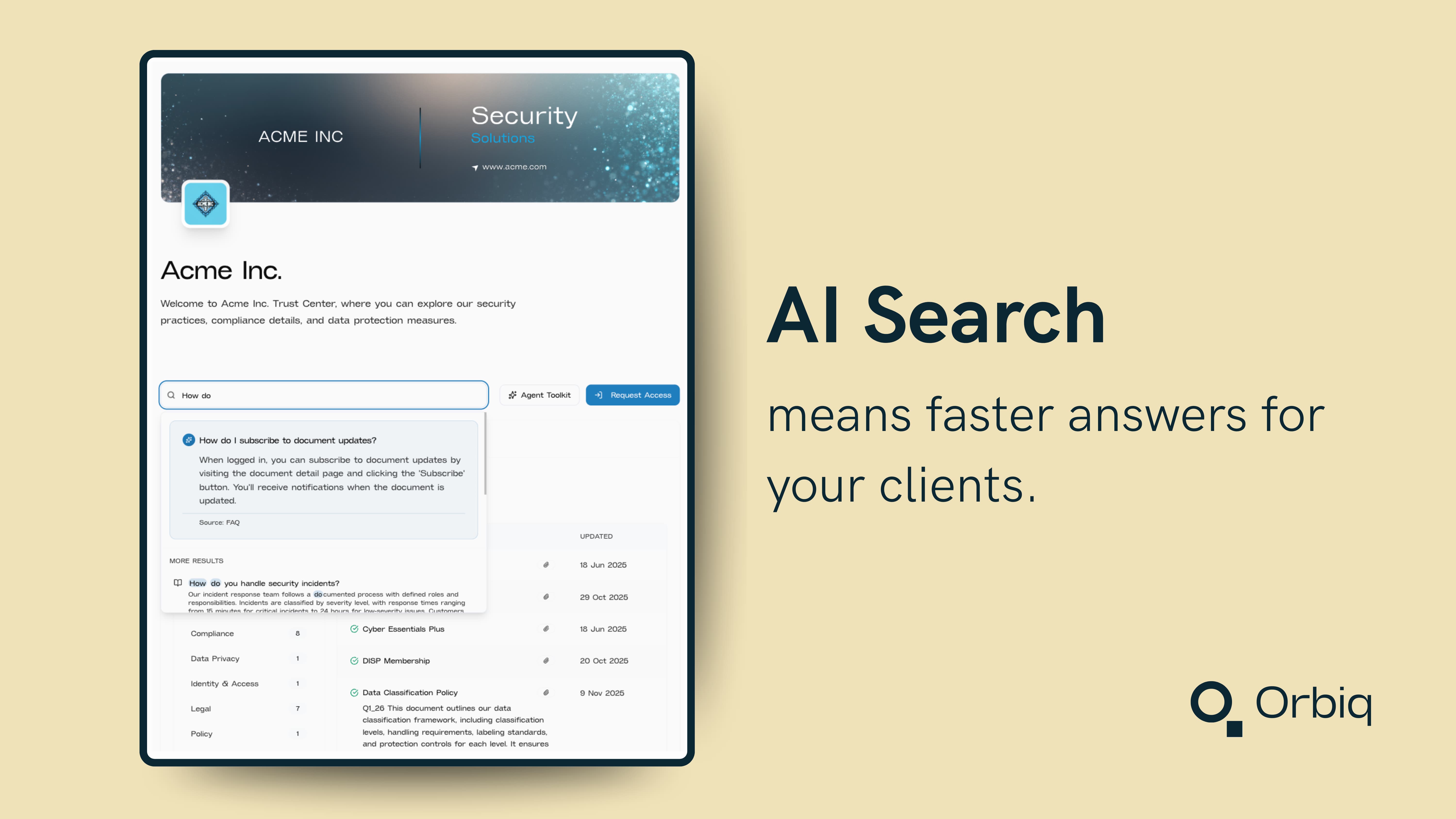
Orbiq is a European‑built trust center platform that treats **GDPR and EU data residency as foundational constraints**, not optional checkboxes. It targets EU startups and mid‑market companies that need a professional, branded trust center without being forced into a full GRC suite or enterprise‑tier pricing.
**Strengths**
- **EU-hosted by default**
Infrastructure is EU-first, so you don't have to negotiate special "EU region" contracts or pay for enterprise SKUs just to keep data in the EU. This directly addresses one of the biggest complaints EU buyers have about US‑centric tools.[9](#ref-9),[1](#ref-1),[12](#ref-12),[3](#ref-3),[20](#ref-20)
- **Three-tier document access controls**
Public, password‑protected, and NDA‑restricted content in a single, simple UI. This mirrors advanced controls in enterprise‑oriented tools but at mid‑market‑friendly complexity and price points.[1](#ref-1),[2](#ref-2),[12](#ref-12)
- **Subprocessor transparency done right**
Vendors and locations are displayed clearly, making it easy for procurement and DPOs to confirm EU data residency at a glance. This aligns with what security teams say they actually want from a trust portal: a self‑serve way to check hosting and subprocessors quickly.[19](#ref-19),[22](#ref-22),[26](#ref-26)
- **Branding and visitor experience**
Deep theming (logo, banner, fonts, colour palette) and a fast, clean, mobile‑friendly interface that marketing would actually sign off on — a gap community threads often complain about in more utilitarian portals.[1](#ref-1),[3](#ref-3),[19](#ref-19)
- **EU‑relevant content structure**
DPA, subprocessor list, privacy policy, ISO 27001 and NIS2‑aligned documentation are first‑class citizens instead of being hidden behind US‑centric frameworks.[4](#ref-4),[5](#ref-5)
- **AI‑powered search and AI‑ready structure**
Visitors can ask natural‑language questions within the trust center. Content is structured so that buyer‑side AI assistants (procurement, risk teams) can pull accurate answers from it, instead of hallucinating around missing or unstructured data.[15](#ref-15),[16](#ref-16),[1](#ref-1),[18](#ref-18),[2](#ref-2)
- **Pragmatic integrations**
API, webhooks (for Slack/Teams alerts when visitors access sensitive content), and document sync with tools like Google Docs, SharePoint, and Confluence.[1](#ref-1),[18](#ref-18),[2](#ref-2),[3](#ref-3)
- **Transparent pricing and free tier**
Pricing is published, with a meaningful free tier and paid tiers starting below typical enterprise price points. This aligns with what founders and security engineers on Reddit say they want: a simple, affordable portal, not a surprise‑priced "enterprise" add‑on.[12](#ref-12),[3](#ref-3),[20](#ref-20)
**Considerations**
- **No deep CRM native integration yet**
Out‑of‑the-box Salesforce/HubSpot workflows are limited; integrations are currently API/webhook‑driven or done case‑by‑case.
- **Not a full GRC platform**
If you are explicitly looking for a one‑stop shop for audits, continuous monitoring, and vendor risk, you will still need a separate GRC/compliance solution — typically dedicated [ISMS software](/compliance-automation/best-isms-software) or broader [compliance automation software](/compliance-automation/compliance-automation-software) running alongside your trust center.[9](#ref-9),[1](#ref-1),[12](#ref-12),[3](#ref-3)
**Best for**
European startups and mid‑market SaaS companies that want a **visitor‑friendly, EU‑first trust center** with professional access controls, but without the cost and complexity of US‑centric, GRC‑bundled options.
### SafeBase (by Drata)
**Overview**
SafeBase was one of the earliest dedicated trust center platforms and is widely used by US SaaS companies to centralize security documentation and automate security reviews.[6](#ref-6),[7](#ref-7),[27](#ref-27),[2](#ref-2),[8](#ref-8),[28](#ref-28) Following its acquisition, it now sits within the Drata ecosystem, which is a leading SOC 2/ISO compliance automation tool.[29](#ref-29),[9](#ref-9),[1](#ref-1),[12](#ref-12) EU buyers weighing this combination should also review the [Drata alternatives](/comparisons/drata-trust-center-alternative) built for European data residency.
**Strengths**
- **Rich feature set for enterprise security teams**
Custom rules engines, tiered permission profiles, progressive disclosure, detailed analytics, and support for complex NDA workflows and CRM integrations.[7](#ref-7),[1](#ref-1),[2](#ref-2),[8](#ref-8)
- **AI-powered questionnaire assistance**
SafeBase leans heavily into AI‑assisted answering of security questionnaires, drawing on your existing documents and knowledge base. This aligns with what many comparison blogs and vendors highlight as a major value driver for trust centers.[1](#ref-1),[18](#ref-18),[2](#ref-2),[3](#ref-3)
- **Deep integrations**
Native Salesforce, Slack/Teams, Jira, DocuSign, Ironclad, and more, making SafeBase attractive for revenue and legal teams who want trust center activity tied directly into their existing workflows.[7](#ref-7),[1](#ref-1),[2](#ref-2),[8](#ref-8)
- **Analytics tied to pipeline**
SafeBase emphasizes connecting trust center interactions to opportunities and ARR — something GTM teams care deeply about and that few purely technical portals offer.[7](#ref-7),[2](#ref-2),[3](#ref-3)
**Considerations**
- **US‑centric by default**
Hosting defaults and product focus are US‑first. EU data residency tends to require enterprise‑tier contracts or specific arrangements, which can be a sticking point for EU‑based buyers with strict data‑location requirements.[9](#ref-9),[1](#ref-1),[12](#ref-12),[3](#ref-3)
- **Complexity and implementation time**
The same depth that benefits large teams can lead to longer onboarding and a steeper learning curve for smaller organizations.
- **Pricing opacity and enterprise focus**
Public materials push "contact sales" and position SafeBase at the enterprise end of the market. This matches the frustration expressed by founders and security engineers looking for simple, transparent, affordable portals.[1](#ref-1),[12](#ref-12),[3](#ref-3),[20](#ref-20)
**Best for**
Large or fast‑growing companies (especially with US operations) that want an **enterprise‑grade trust center with heavy CRM integration and advanced workflows**, and are comfortable with a sales‑led, higher‑priced engagement.
### Vanta Trust Center
**Overview**
Vanta is a leading compliance automation platform, and its trust center is an **add‑on to the core Vanta product** rather than a standalone tool.[9](#ref-9),[1](#ref-1),[12](#ref-12),[3](#ref-3),[30](#ref-30),[31](#ref-31) For organizations already using Vanta for SOC 2/ISO/DORA work, the trust center is a natural extension.
**Strengths**
- **Tight integration with compliance data**
Vanta automatically surfaces real‑time compliance status and controls in the trust center, reducing double‑entry and keeping portal content in sync with your live control environment.[9](#ref-9),[1](#ref-1),[3](#ref-3)
- **Native AI features across the platform**
Vanta markets AI assistance across use cases (e.g. helping address questionnaires and streamline evidence gathering), and these capabilities can complement the trust center.[9](#ref-9),[1](#ref-1),[3](#ref-3),[30](#ref-30)
- **Simple path for existing customers**
If your compliance program already lives in Vanta, turning on their trust center is operationally straightforward.
**Considerations**
- **Most value comes from the broader platform**
As of 2026 Vanta sells Trust Center *both* as a standalone product and as an add-on to an existing Vanta plan, so you no longer have to buy the full GRC suite to get it.[9](#ref-9) In practice, though, the trust center's biggest advantage — live, auto-synced compliance status — only materialises when your control environment already lives in Vanta.[1](#ref-1),[12](#ref-12),[3](#ref-3)
- **US‑centric hosting; EU residency is opt‑in**
Hosting defaults and pricing logic follow Vanta's broader platform. EU data residency (an AWS Frankfurt option) is available but **opt‑in, not the default**, so EU buyers must request and verify it rather than assume it.[9](#ref-9),[30](#ref-30),[31](#ref-31),[25](#ref-25)
- **Limited EU‑specific positioning**
While Vanta supports ISO and other international frameworks, most marketing and case studies focus on SOC 2 and US‑driven use cases.[9](#ref-9),[1](#ref-1),[12](#ref-12),[3](#ref-3)
**Best for**
Existing Vanta customers who want a **trust center tightly coupled to their compliance automation**, and for whom EU hosting and EU‑first messaging are not the primary requirements.
> Looking for a Vanta alternative? See our in-depth comparison: [Best Vanta Alternative for EU Companies (2026)](/comparisons/vanta-trust-center-alternative)
### Secureframe Trust Center
**Overview**
Secureframe is another major compliance automation vendor. Its trust center is, again, a **feature of the broader Secureframe platform**, not a separate product.[10](#ref-10),[11](#ref-11),[1](#ref-1),[12](#ref-12),[3](#ref-3)
**Strengths**
- **Unified compliance + trust center**
Secureframe can publish artifacts and statuses from its compliance workflows directly into the trust center, which simplifies maintenance if you're already all‑in on Secureframe.[10](#ref-10),[11](#ref-11),[1](#ref-1),[12](#ref-12),[3](#ref-3)
- **Showcase of customer trust centers**
Secureframe publicly highlights customer trust centers (for example, fintech and SaaS customers), demonstrating real‑world usage and layouts.[32](#ref-32),[11](#ref-11),[33](#ref-33)
**Considerations**
- **Requires Secureframe as your GRC backbone**
Similar to Vanta, Secureframe's trust center only makes sense if you are already using the platform for audits/compliance.
- **EU hosting often a special case**
EU data residency generally requires more negotiation and may not be standard on lower tiers.[10](#ref-10),[1](#ref-1),[12](#ref-12),[3](#ref-3)
- **Enterprise‑leaning go‑to‑market**
Pricing is not typically published; buyers report sales‑led processes and enterprise‑oriented bundles.[1](#ref-1),[12](#ref-12),[3](#ref-3)
**Best for**
Companies that are **already Secureframe customers** and want to avoid adding yet another vendor just for a trust portal.
### Conveyor
**Overview**
Conveyor positions itself strongly around **security questionnaire automation**, with a trust portal as part of that offering.[1](#ref-1),[3](#ref-3),[28](#ref-28),[13](#ref-13),[14](#ref-14) It's often mentioned as a top alternative to SafeBase and as a way to reduce questionnaire workload.[7](#ref-7),[28](#ref-28),[14](#ref-14),[34](#ref-34)
**Strengths**
- **AI-first questionnaire automation**
Conveyor focuses heavily on AI-powered answering of security questionnaires, pulling from your policies, evidences, and prior answers.[1](#ref-1),[18](#ref-18),[3](#ref-3),[13](#ref-13),[14](#ref-14) For teams crushed under 200+ question spreadsheets, this can be a major relief.
- **Standalone deployment**
Unlike Vanta/Drata/Secureframe, Conveyor can be adopted without ripping or replacing your existing compliance stack.[1](#ref-1),[18](#ref-18),[3](#ref-3),[13](#ref-13)
- **Transparent pricing and free options**
Public, usage‑based pricing makes it more accessible than many enterprise‑only offerings. As of 2026 Conveyor publishes a **$0/year tier** (10 trust center credits per month) and a full platform tier **starting at $9,600/year** with unlimited seats and 100 credits — a credit being one processed questionnaire.[3](#ref-3),[13](#ref-13)
**Considerations**
- **Trust center not always the hero**
Many of Conveyor's materials and comparisons highlight questionnaire automation over the portal itself. If your primary need is a polished customer‑facing portal rather than automation, this might feel secondary.[1](#ref-1),[3](#ref-3),[13](#ref-13),[14](#ref-14)
- **US‑centric**
While usable by EU companies, the default posture and messaging are US‑focused. EU data residency requirements may require extra diligence.
**Best for**
Security and revenue teams whose **primary pain is questionnaire volume**, and who are comfortable with a US‑centric product where the trust center is part of a broader automation story.
### TrustCloud (TrustCloud + TrustShare)
**Overview**
TrustCloud (formerly Kintent) markets itself as a **security assurance and trust management platform**, with strong vendor risk capabilities and an AI governance narrative.[15](#ref-15),[16](#ref-16),[17](#ref-17),[1](#ref-1),[12](#ref-12) Its TrustShare product powers public trust centers.[16](#ref-16),[35](#ref-35)
**Strengths**
- **AI-heavy "Assurance AI"**
TrustCloud emphasizes "hallucination-resistant" AI that is governed and auditable, which resonates with organizations sensitive to AI governance and upcoming AI regulations.[15](#ref-15),[16](#ref-16),[17](#ref-17),[18](#ref-18),[2](#ref-2)
- **Enterprise‑grade trust and vendor risk**
It combines trust centers with vendor risk management and broader assurance workflows, which can appeal to larger organizations with mature risk programs.[15](#ref-15),[16](#ref-16),[17](#ref-17),[1](#ref-1),[12](#ref-12)
**Considerations**
- **Enterprise complexity and pricing**
The product is aimed at larger enterprises; pricing is not public and is typically handled via sales.[15](#ref-15),[16](#ref-16),[1](#ref-1),[12](#ref-12)
- **US‑centric and GRC‑adjacent**
Similar to other platforms in this cohort, it is more US‑oriented and geared towards enterprises combining internal controls, third‑party risk, and assurances.[15](#ref-15),[16](#ref-16),[1](#ref-1),[12](#ref-12)
**Best for**
Large organizations that want **trust centers as part of a broader, AI‑governed security assurance and vendor risk program**, and have the budget and complexity to match.
### Other Notable Options
Several other vendors appear frequently in "best trust center software" lists and comparison guides, even if they're not the core focus of this article:
- **Scytale** – Compliance automation platform with a trust center feature, primarily focused on SOC 2/ISO automation.[4](#ref-4),[3](#ref-3),[21](#ref-21)
- **Vendict** – AI‑driven security questionnaire platform that includes a trust portal; strong AI story, especially for startups and mid‑market.[18](#ref-18),[3](#ref-3)
- **SecurityPal** – Questionnaire automation with trust center capabilities, often mentioned alongside Conveyor and SafeBase.[1](#ref-1),[3](#ref-3)
- **UpGuard** – Offers a free trust portal option that early‑stage founders sometimes adopt when budgets are tight.[12](#ref-12),[3](#ref-3),[20](#ref-20)
For many EU buyers, these tools are worth a look if you are already evaluating them for GRC or questionnaire automation, but they often share the same US‑centric and GRC‑bundled traits described above.[1](#ref-1),[18](#ref-18),[12](#ref-12),[4](#ref-4),[3](#ref-3)
## Key Decision Factors for European Buyers
### 1. Data Residency, Data Sovereignty, and EU Regulation
Where your trust center stores and processes data — and which jurisdiction's laws govern that data — affects both **legal exposure** and **customer confidence**. This is the heart of what to look for in a [European Trust Center](/trust-center/european-trust-center).
**Data residency** ensures data physically stays within a jurisdiction. **Data sovereignty** ensures it remains subject to that jurisdiction's laws and is not exposed to foreign government access claims (like the US CLOUD Act). For a deeper dive into how these concepts differ and why buyers often conflate them, see [EU Data Sovereignty vs. Residency: What SaaS Buyers Get Wrong](/blog/data-residency-vs-sovereignty).
Patterns from vendor materials and community discussions:
- Many US‑headquartered platforms default to US hosting, with **EU regions offered as enterprise add‑ons or special configurations**.[9](#ref-9),[1](#ref-1),[12](#ref-12),[3](#ref-3)
- "EU hosting" from a US vendor may still leave your data subject to US legal access — true sovereignty requires EU-based infrastructure and corporate structure.
- EU buyers in regulated sectors increasingly expect **EU data sovereignty** (not just hosting) and clear subprocessors, especially with NIS2, DORA, and AI‑related regulations tightening.[4](#ref-4),[5](#ref-5),[19](#ref-19),[20](#ref-20)
Practical guidance:
- If you are an EU data controller, assume **US‑default hosting + opaque subprocessors is a serious red flag** unless contractually mitigated.
- Prefer platforms that:
- provide **EU data sovereignty** by default (EU-based infrastructure, not just "EU region" options),
- provide a clear, up‑to‑date subprocessor list with locations,
- and make DPAs and TIAs straightforward to access and review.[4](#ref-4),[5](#ref-5),[19](#ref-19),[20](#ref-20)
One practical signal: **Orbiq** is built for European buyers and treats GDPR and EU data residency as foundational constraints — which is the opposite of "EU hosting as an enterprise add‑on."
### 2. Bundled GRC Suite vs Standalone Trust Center
There is a structural split in the market:
- **Bundled into GRC**: Vanta, Drata, Secureframe, Scytale, OneTrust, Hyperproof.[10](#ref-10),[9](#ref-9),[1](#ref-1),[12](#ref-12),[4](#ref-4)
- **Standalone or questionnaire‑first**: Conveyor, TrustCloud TrustShare, Vendict, SecurityPal, Orbiq.[16](#ref-16),[1](#ref-1),[18](#ref-18),[3](#ref-3),[20](#ref-20)
Decision rules:
- If you are **already** running one of the big GRC suites (Vanta, Drata, Secureframe, etc.), enabling their trust center can be the fastest and least disruptive path.[10](#ref-10),[9](#ref-9),[1](#ref-1),[12](#ref-12),[4](#ref-4)
- If you are **not** using those platforms, be cautious about buying a full GRC stack **just** to get a trust center. Standalone products can be:
- cheaper,
- simpler to deploy,
- and less opinionated about how you run compliance.[1](#ref-1),[18](#ref-18),[12](#ref-12),[3](#ref-3),[20](#ref-20)
If you want a standalone trust center without a full GRC suite, **Orbiq** is a representative "portal-first" option aimed at EU startups and mid‑market companies.
### 3. AI and Questionnaire Automation
AI is not just marketing fluff here — for many teams, **automated questionnaire assistance** is the main ROI lever.
What the ecosystem shows:
- Platforms like Orbiq, Conveyor, TrustCloud, Vendict, SafeBase, and others heavily emphasize AI‑based questionnaire answering, often with security‑trained models and guardrails.[15](#ref-15),[16](#ref-16),[1](#ref-1),[18](#ref-18),[2](#ref-2)
- Practitioners in security and startup communities report that this AI help can significantly cut response time, but they still maintain human review for final answers.[19](#ref-19),[22](#ref-22),[26](#ref-26)
Decision rules:
- If your team spends **dozens of hours per month** on security questionnaires, prioritize platforms with:
- mature AI answer engines,
- good document and knowledge‑base sync,
- and explicit controls to prevent hallucinated answers.[15](#ref-15),[16](#ref-16),[1](#ref-1),[18](#ref-18),[2](#ref-2)
- If your primary problem is **visibility and professionalism** (not volume), a simpler, portal‑centric tool may be a better fit.
This is where **Orbiq** tends to fit: portal‑centric by design, with emerging AI features that are replacing high‑volume questionnaire workflows.
### 4. Budget and Pricing Transparency
Price sensitivity and frustration with opaque pricing are recurring themes:
- Third‑party comparisons and Slashdot‑style lists highlight that many trust center capabilities sit behind **enterprise‑only pricing and "contact sales" walls**.[1](#ref-1),[12](#ref-12),[3](#ref-3)
- Founders and small security teams on Reddit explicitly look for **genuinely free or low‑cost** trust center options and complain about "skimming" by high‑end vendors.[12](#ref-12),[3](#ref-3),[20](#ref-20)
Decision rules:
- If you are **pre‑Series A or early revenue**, you likely should not be forced into four‑ or five‑figure annual contracts just to host a basic trust portal.
- Look for:
- published price pages,
- free or genuinely affordable starter tiers,
- and the ability to add advanced workflows later when you truly need them.[12](#ref-12),[3](#ref-3),[20](#ref-20)
In practice, **Orbiq** stands out here by offering public pricing and a free tier, which is still uncommon among trust center vendors.
### 5. Visitor Experience Matters More Than You Think
A trust center is not just a security asset; it is a **customer‑facing product**.
From practitioner and buyer discussions:
- Security teams like having a **bookmarkable place** where they can self‑serve SOC reports, DPAs, and privacy details, rather than chasing PDFs over email.[19](#ref-19),[22](#ref-22),[26](#ref-26)
- Some buyers complain that portals can feel cluttered, ugly, or hard to navigate — especially when built as a thin veneer over a compliance dashboard.[1](#ref-1),[3](#ref-3),[19](#ref-19)
What to aim for:
- Make **basic information public** (certifications, high‑level security overview, data residency, subprocessors) so security teams can quickly qualify you.[2](#ref-2),[19](#ref-19),[22](#ref-22),[26](#ref-26)
- Gate **sensitive documents** (full SOC reports, pen tests) behind NDA or approval workflows, ideally with clickwrap NDAs or lightweight request flows.[9](#ref-9),[1](#ref-1),[2](#ref-2),[19](#ref-19),[22](#ref-22)
- Prioritize **clarity and scannability**:
- consistent layout,
- clear groupings (e.g. "Policies", "Certifications", "Data Protection"),
- and fast load times on mobile and desktop.
Tools like **Orbiq** differentiate most on this factor: a visitor‑friendly, scannable trust portal that feels like a product page, not a compliance dashboard.
## AI-Native Trust Centers in 2026
A new evaluation axis emerged in 2026: can an **AI agent** read your trust center, not just a human? Buyer-side procurement and security teams are piloting AI assistants that research vendors, score risk, and pre-fill questionnaires — and they increasingly expect to query a vendor's security posture programmatically rather than download PDFs.[2](#ref-2),[3](#ref-3)
The supply side is still immature. As of 2026 there is **no cross-vendor standard** for machine-readable trust evidence: most trust centers expose evidence in human-oriented portals plus conventional integrations, and proposals like `llms.txt` (a curated, AI-readable map of a site's key content) remain niche — adoption is low and uneven, major AI providers have not committed to it, and measurable citation benefit is so far unproven. Treat an "AI-native" trust center as **forward-looking signalling and genuine future-proofing**, not a settled standard. For the full picture of where this is heading — machine-readable evidence, citation contracts, NDA-gated AI access, and versioned evidence — see our deep dive on the [AI-native Trust Center](/trust-center/ai-native-trust-center).
What to actually look for in 2026:
- **Structured, current content** an AI assistant can extract accurately (clear certifications, subprocessors, data residency) instead of scanning image-only PDFs.
- **Natural-language search inside the portal**, so a visitor's own AI tools get accurate answers rather than hallucinating around gaps.
- **A clear access model for automated agents** — what is public, what sits behind an NDA or approval, and how machine access is governed.
### Two 2026 factors, by platform
This table isolates the two dimensions that changed most this year — genuine **EU data sovereignty** (EU infrastructure and corporate structure, not just an "EU region" toggle) and **AI-readable / agent-ready evidence**.
| Platform | EU data sovereignty (default?) | AI-readable / agent-ready evidence |
|---|---|---|
| **Orbiq** | EU-first by default (EU infrastructure + EU corporate structure) | AI search in-portal; content structured for buyer-side AI assistants |
| **SafeBase (by Drata)** | US-default; EU via higher tiers/arrangement | Strong AI questionnaire assistance; portal human-first |
| **Vanta Trust Center** | US-default; EU (AWS Frankfurt) opt-in, not default | Platform-wide AI features; no public agent standard |
| **Secureframe Trust Center** | US-default; EU hosting by arrangement | Compliance-data-first; less AI-forward |
| **Conveyor** | US-centric | One of the strongest AI questionnaire engines; portal secondary |
| **TrustCloud** | US-centric | "Hallucination-resistant" Assurance AI; enterprise-oriented |
EU data sovereignty is the harder gate to clear: a US-incorporated vendor can fall under the US CLOUD Act regardless of where data is physically hosted, which is exactly the conflict EU buyers in regulated sectors are trying to avoid under GDPR, NIS2, and DORA. This is the central argument of a dedicated [European Trust Center](/trust-center/european-trust-center) and the [Trust Center vs. GRC tool comparison for European buyers](/comparisons/trust-center-vs-grc-tool-european-buyers).
A note on the wider European market: this is not an EU-27 question alone. Buyers in the **UK** apply UK GDPR (retained post-Brexit) and will soon weigh the incoming Cyber Security and Resilience Bill, while **Norway** and the EEA apply GDPR via the EEA Agreement under Datatilsynet — so "European data residency" for a pan-European seller means EU **and** EEA **and** UK expectations, not just one of them.
## Who Is Actually Driving the Purchase? A Stakeholder Matrix
Trust center buying is rarely owned by one team. The right platform often depends on **who leads the evaluation** — and each stakeholder weights the factors above differently. Map your own buying committee against this matrix:
| Lead stakeholder | Primary question | Weights most | Tends to favour |
|---|---|---|---|
| **Legal / DPO** | "Where does our data legally sit, and can I access DPAs and subprocessors?" | EU data sovereignty, DPA/SCC access, subprocessor transparency | EU-built standalone portals ([legal-team trust workflows](/trust-center/trust-center-for-legal-teams)) |
| **Security / CISO** | "Can I gate SOC reports and pen tests behind an NDA and prove control status?" | Access controls, evidence freshness, ISO 27001/NIS2 alignment | Bundled GRC trust centers if already on the suite; otherwise standalone |
| **Procurement / Vendor risk** | "Can I qualify this vendor fast without a 200-question spreadsheet?" | Questionnaire automation, self-serve public info, completeness | Questionnaire-first tools (Conveyor) or AI-search portals |
| **AI agent / automated buyer** | "Can I extract an accurate, current answer programmatically?" | Machine-readable structure, public scannability, citation clarity | Portals with structured, AI-readable evidence (see [AI-native Trust Center](/trust-center/ai-native-trust-center)) |
If your evaluations are increasingly led by procurement automation and buyer-side AI, weight machine-readability and public scannability higher than CRM depth. If legal owns the decision, EU data sovereignty and document access usually outrank everything else. For the broader category framing, the [ultimate guide to trust centers](/trust-center/ultimate-guide-to-trust-centers) walks through each stakeholder lane in detail.
## Frequently Asked Questions
### What is a trust center?
A trust center is a **public web portal** where a company shares its security, privacy, and compliance information — including policies, certifications, subprocessors, and key documents — so that customers and partners can self‑serve answers to security questions.[1](#ref-1),[2](#ref-2),[3](#ref-3)
In practice, security and procurement teams increasingly expect vendors to have a trust center they can bookmark and revisit, rather than passing static PDFs around.[19](#ref-19),[22](#ref-22),[26](#ref-26)
### How does a trust center reduce sales cycle time?
Trust centers can significantly **compress the security review phase** of a deal by:
- Giving prospects immediate access to security and compliance information they usually request via spreadsheets and email.
- Reducing back‑and‑forth on common questions ("Where is data hosted?", "Do you support ISO 27001?", "Who are your subprocessors?").[1](#ref-1),[2](#ref-2),[3](#ref-3),[19](#ref-19),[22](#ref-22)
Vendors, case studies, and community stories consistently report fewer inbound questionnaires, shorter review cycles, and less time spent by security teams on repeat answers once a good trust center is in place.[9](#ref-9),[1](#ref-1),[2](#ref-2),[3](#ref-3),[19](#ref-19)
### What's the difference between data residency, data sovereignty, and GDPR compliance?
- **Data residency** means your data physically resides in a specific jurisdiction (e.g., EU data centers). It's about where data is stored.
- **Data sovereignty** goes further — it ensures data remains subject only to that jurisdiction's laws and is not exposed to foreign government access claims like the US CLOUD Act. This is critical for European companies concerned about extraterritorial reach.
- **GDPR compliance** covers how personal data is collected, processed, shared, and secured — regardless of where it is hosted.
For European companies, **all three matter**: residency for physical location, sovereignty for legal protection, and GDPR compliance for lawful processing. Many US-based platforms may offer "EU hosting" but still fall under US jurisdiction, making true data sovereignty impossible without careful contractual arrangements.[4](#ref-4),[5](#ref-5)
### Should I require login to access my trust center?
Best practice seen across many trust centers and community consensus:
- Make **basic information public**:
- high‑level security overview,
- certifications,
- data residency and subprocessors,
- and privacy policy.[1](#ref-1),[2](#ref-2),[19](#ref-19),[22](#ref-22),[26](#ref-26)
- Gate **sensitive content** behind lightweight access controls:
- clickwrap NDAs,
- magic‑link or SSO‑based access,
- or approval workflows for reports like full SOC reports and pen test summaries.[9](#ref-9),[1](#ref-1),[2](#ref-2),[19](#ref-19),[22](#ref-22)
This strikes a balance between **frictionless qualification** for prospects and **controlled access** for detailed materials.
## Methodology & Disclosure
This comparison is built from:
- Public vendor documentation and product pages.
- Independent comparison articles and listicles from security‑focused blogs and SEO analysts.[1](#ref-1),[18](#ref-18),[12](#ref-12),[3](#ref-3),[21](#ref-21)
- Vendor product pages, public trust centers, and accessible press or customer pages.[9](#ref-9),[29](#ref-29),[30](#ref-30),[31](#ref-31),[33](#ref-33),[35](#ref-35)
- Community discussions in security and startup forums, especially threads where practitioners share how they use trust centers, what frustrates them, and which tools they've adopted.[19](#ref-19),[22](#ref-22),[20](#ref-20),[26](#ref-26),[36](#ref-36)
The focus is intentionally on **fit for European buyers**, especially those who care about GDPR, NIS2, DORA, and EU data residency.
**Disclosure:** This article appears on the Orbiq website. Orbiq is a trust center platform designed primarily for European companies. Every effort has been made to:
- fairly describe competitors' strengths and where they are a better fit, and
- clearly state where Orbiq's approach is opinionated (EU‑first data residency, visitor‑friendly UX, transparent pricing).
Pricing and features change frequently. Always verify current details with vendors before making a decision.
If you are evaluating trust center options and operate primarily in Europe, it is worth creating a short requirements list (EU data residency, questionnaire volume, budget, bundled vs standalone) and mapping each vendor against it — the decision factors in this guide should give you a practical starting checklist.
---
## Related reading
- [What is a Trust Center?](/trust-center/what-is-a-trust-center)
- [The European Trust Center](/trust-center/european-trust-center)
- [The AI-Native Trust Center](/trust-center/ai-native-trust-center)
- [Trust Center vs. GRC Tool for European Buyers](/comparisons/trust-center-vs-grc-tool-european-buyers)
- [SafeBase Alternative for EU Companies](/comparisons/safebase-alternative)
- [Trust Center vs. ISMS vs. Deal Room](/comparisons/trust-center-vs-isms-vs-deal-room)
- [EU Data Sovereignty vs. Residency](/blog/data-residency-vs-sovereignty)
## Sources
1. [What It Means to Be a "Trust Center" and Top Vendors
That ...](https://www.securitypalhq.com/blog/top-trust-center-vendors)
2. [How a Trust Center Solves Your Security Questionnaire
...](https://thehackernews.com/2024/07/how-trust-center-solves-your-security.html)
3. [The Complete Guide to the Best Trust Center Software](https://saasyseo.com/trust-center-software/)
4. [Trust Center - Scytale](https://scytale.ai/trust-center/)
5. [SAP Trust Center | Security, Privacy, Cloud Status &
More](https://www.sap.com/about/trust-center.html)
6. [SafeBase company profile](https://www.ycombinator.com/companies/safebase)
7. [Drata to Acquire SafeBase](https://www.prnewswire.com/news-releases/drata-to-acquire-safebase-accelerating-trust-management-within-enterprise-governance-risk-and-compliance-302373195.html)
8. [Drata Launches Trust Center](https://www.prnewswire.com/news-releases/drata-launches-trust-center-to-help-companies-prove-their-security-and-compliance-posture-301560018.html)
9. [Prove trust to customers before they ask with Trust Center](https://www.vanta.com/products/trust-center)
10. [Secureframe for Government - Carahsoft](https://www.carahsoft.com/secureframe)
11. [Compliance](https://finch.secureframetrust.com/?format=html)
12. [Trust Center Examples and Best Practices](https://www.webstacks.com/blog/trust-center-examples)
13. [Conveyor SafeBase Alternatives](https://www.conveyor.com/blog/safebase-alternatives)
14. [Conveyor vs. Safebase](https://www.conveyor.com/compare/conveyor-vs-safebase)
15. [Integrated Security Assurance Platform to Build Trust](https://www.trustcloud.ai/trustcloud/)
16. [Security Questionnaire Automation & Trust Portal](https://www.trustcloud.ai/trustshare/)
17. [TrustCloud: Security Assurance Platform for hybrid
enterprises](https://www.trustcloud.ai)
18. [Trust Center Software: Build Customer Trust Faster](https://vendict.com/trust-center-product)
19. [Trust centre : r/cybersecurity](https://www.reddit.com/r/cybersecurity/comments/1mec5rt/trust_centre/)
20. [Affordable Trust Center portal : r/cybersecurity](https://www.reddit.com/r/cybersecurity/comments/1kx2yqf/affordable_trust_center_portal/)
21. [Top 5 Trust Center Software in 2026](https://ithikios.com/en/top-5-trust-center-software-in-2026/)
22. [Is it rude to send people to a trust center? : r/cybersecurity](https://www.reddit.com/r/cybersecurity/comments/1md6ss5/is_it_rude_to_send_people_to_a_trust_center/)
23. [Vanta Trust Center Product Page](https://www.vanta.com/products/trust-center)
24. [Vanta Integrations](https://www.vanta.com/integrations)
25. [Vanta Legal DPA](https://www.vanta.com/legal/dpa)
26. [Are you using a trust portal? - cybersecurity](https://www.reddit.com/r/cybersecurity/comments/1ay7y0g/are_you_using_a_trust_portal/)
27. [SafeBase: Trust Center platform that scales customer
security reviews](https://www.ycombinator.com/companies/safebase)
28. [SafeBase overview](https://www.ycombinator.com/companies/safebase)
29. [Drata Launches Trust Center to Help Companies Prove
Their Security and Compliance Posture](https://www.prnewswire.com/news-releases/drata-launches-trust-center-to-help-companies-prove-their-security-and-compliance-posture-301560018.html)
30. [Vanta continues to lead the G2 Grid for Security ...](https://www.vanta.com/resources/g2-winter-2024)
31. [Celebrating 1000 reviews on G2 and our first-ever ...](https://www.vanta.com/resources/1000-g2-reviews-customer-week)
32. [A Trust Center is a dedicated webpage where ...](https://www.linkedin.com/posts/secureframe_a-trust-center-is-a-dedicated-webpage-where-activity-7249069778873520129-XQ8j)
33. [Boardable | Trust Center](https://boardable.secureframetrust.com/?format=html)
34. [SafeBase Alternatives: Conveyor and 4 Other Competitors
to Evaluate](https://www.conveyor.com/blog/safebase-alternatives)
35. [TrustCloud Trust Center - Powered by TrustShare](https://community.trustcloud.ai/company/trustcloud/)
36. [Free Trust Center for Startups](https://www.reddit.com/r/startup/comments/1lrbhzg/free_trust_center_for_startups/)
37. [Trust Center Examples](https://www.webstacks.com/blog/trust-center-examples)
38. [Top Trust Center Vendors](https://www.securitypalhq.com/blog/top-trust-center-vendors)
39. [How a Trust Center Solves Security Questionnaires](https://thehackernews.com/2024/07/how-trust-center-solves-your-security.html)